Sunlu Standard Resin Accuracy Test: Best Resin 3D Printer for Precision & Dimensional Stability

Written By
marketing
Sunlu Standard Resin Accuracy Test: Which Resin 3D Printer Delivers the Best Results?
Introduction
At SWBAC Company, we continuously evaluate the latest resin 3D printing technologies to help engineers, designers, and manufacturers select the most reliable equipment for precision applications.
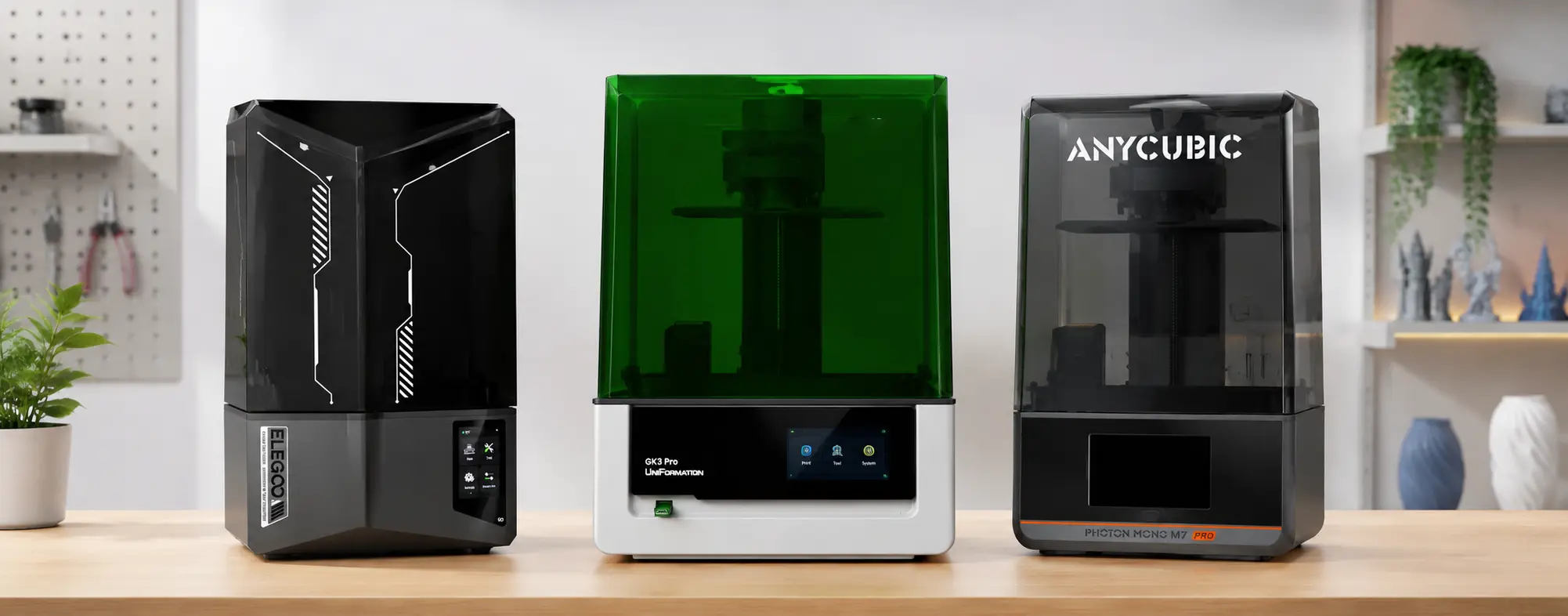
In this study, we assessed the dimensional performance of six popular resin printers using Sunlu Standard Resin, a general-purpose photopolymer resin known for its excellent print quality, smooth surface finish, ease of printing, and affordability.
To ensure a fair comparison, all printed parts were post-cured for 1 minute and 30 seconds before any measurements were taken.
The evaluation focused on two critical aspects of print quality:
-
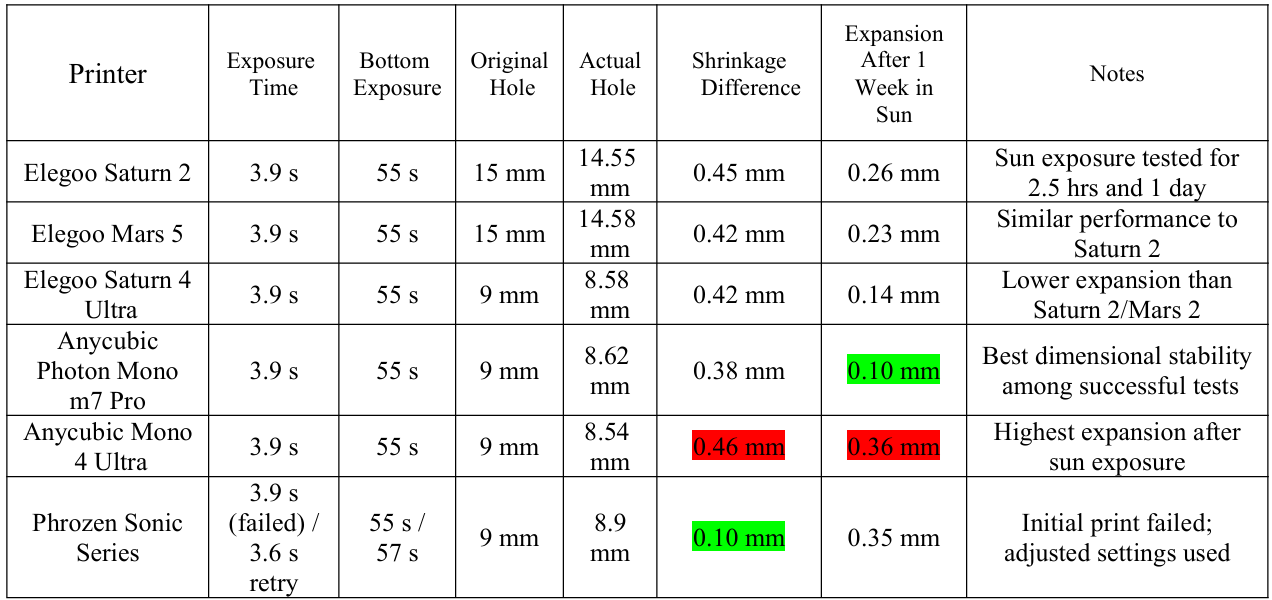
Initial dimensional accuracy, measured by comparing the designed hole diameter with the printed hole diameter (hole diameter deviation).
-
Long-term dimensional stability, measured by the change in the specimen's overall length after one week of direct sunlight exposure, representing the effects of continued UV curing.
Test Conditions
-
Resin: Sunlu Standard Resin
-
Post-curing: All printed specimens were cured for 1 minute and 30 seconds before testing.
-
Standard Exposure Time: 3.9 s
-
Bottom Exposure Time: 55 s
-
Exception: The Phrozen Sonic Series required optimized settings (3.6 s exposure, 57 s bottom exposure, and 6.5 mm bottom lift distance) after the initial settings failed.
-
Printers Tested:
-
Elegoo Saturn 2
-
Elegoo Mars 5
-
Elegoo Saturn 4 Ultra
-
Anycubic Photon Mono M7 Pro
-
Anycubic Mono 4 Ultra
-
Phrozen Sonic Series
-
Key Findings
-
Highest Initial Accuracy
-
The Phrozen Sonic Series achieved the smallest hole diameter deviation of 0.10 mm, although it required modified exposure settings to complete the print successfully.
-
-
Best Plug-and-Play Performance
-
The Anycubic Photon Mono M7 Pro delivered the best accuracy using the standard print settings, with a 0.38 mm hole diameter deviation.
-
-
Performance of Other Printers
-
The Elegoo Mars 2 and Elegoo Saturn 4 Ultra each recorded a 0.42 mm hole diameter deviation.
-
The Elegoo Saturn 2 and Anycubic Mono 4 Ultra showed the largest initial deviations, measuring 0.45 mm and 0.46 mm, respectively.
-
-
Long-Term Dimensional Stability
-
After one week of direct sunlight exposure, all printed parts experienced a slight increase in overall length due to continued UV curing.
-
The Anycubic Photon Mono M7 Pro demonstrated the best dimensional stability, with only 0.10 mm of length expansion.
-
The Elegoo Saturn 4 Ultra followed closely with 0.14 mm expansion.
-
The Phrozen Sonic Series and Anycubic Mono 4 Ultra exhibited the greatest expansion, measuring 0.35 mm and 0.36 mm, respectively.
-
Conclusion
The results demonstrate the trade-off between initial printing accuracy and long-term dimensional stability. Although the Phrozen Sonic Series achieved the smallest hole diameter deviation, it required customized exposure settings and showed relatively poor stability after UV exposure.
In contrast, the Anycubic Photon Mono M7 Pro delivered the best overall performance by combining excellent out-of-the-box accuracy with the highest resistance to dimensional changes after sunlight exposure.
For users seeking reliable precision with minimal calibration, the Photon Mono M7 Pro proved to be the strongest all-around performer in this evaluation.
Tags
Categories
3D Printing Kuwait
(1)
Creality Ender 3 Upgrades & Modifications
(1)
3D Printer Upgrades & Calibration
(1)
3D Printing Guides & Tutorials
(1)
Creality CR-10 S5 Upgrades: SKR Mini E3 V3 & Micro Probe Guide
(1)
3D Printer Troubleshooting
(1)
Filament Guides
(1)
Resin 3D Printing
(1)
3D Printing Using TPU Filament
(1)
Robotics for kids
(1)
Recent Posts
Do Kids Need to Learn Robotics?
2026-10-06

Archives
Oct 2026
(1)
Sep 2026
(1)
Jul 2026
(2)
Jun 2026
(6)
More From marketing
Do Kids Need to Learn Robotics?
2026-10-06