


In 3D printing, print quality isn’t dictated by software settings or even the printer itself alone — it’s often determined by the nozzle. That tiny metal tip at the hotend is not just an accessory; it’s the point where thermal physics, mechanical tolerance, and material science converge.
Whether you’re a hobbyist chasing cleaner detail, a production engineer fighting print failures, or a seller aiming to give real value, this guide isn’t the usual list of nozzle sizes. Instead, we’re going deep into performance nuances, overlooked design variables, and buying decisions most professionals get wrong.
Let’s unlock what the manuals don’t tell you.
What is a 3D Printer Nozzle?
The nozzle is the final point of contact between your machine and your print. It’s the outlet for molten filament, operating under intense thermal stress (typically 180°C to 320°C), and its job is to deliver consistent flow, proper layer adhesion, and reliable extrusion pressure.
What most people miss: nozzle geometry internally affects melt pressure. Two nozzles of the same diameter may behave very differently based on tapering, bore length, and polish quality.

Nozzle Tip Diameters and Real-World Use
-
0.2mm – Great for precision, but sensitive to clogs. Best for tuned machines with dry filament.
-
0.4mm – Standard choice balancing flow rate, detail, and reliability. Internal geometry still varies by brand.
-
0.6mm – 0.8mm – Higher flow, faster prints, better for filled or flexible filaments. Ideal for mechanical parts.
-
1.0mm+ – Best for large-format or rapid prototyping. Resolution takes a back seat to speed.
Hidden Insight: Smaller isn’t always better. Tiny nozzles increase pressure and may cause skipping or ghosting on weaker extruders.

Nozzle Materials — Beyond Durability
- Brass – Excellent thermal transfer, ideal for standard filaments. Wears out quickly with abrasives.
- Stainless Steel – Food-safe, less thermal efficient. OK for mild abrasives.
- Hardened Steel – Handles carbon fiber and wood filaments. Requires higher temps. Rougher surface.
- Nickel-Plated Copper – Top-tier thermal performance + corrosion resistance. Best for technical filaments.
- Ruby-Tipped – Brass thermal conductivity with unbeatable wear resistance. Expensive but worth it for pros.
- DLC Coated (e.g. ObXidian, TwinClad) – Ultra-low friction, long life, great for sticky or slow-flow materials.

Nozzle Architecture & Compatibility — Not Just Threads
Nozzle selection involves:
Compatibility Examples:
- Heatbreak design (PTFE vs. All-Metal)
- Filament path setup (Bowden vs. Direct Drive)
- Thread type and bore geometry
- Internal polish and taper
- MK8 – Common, basic, not ideal for high-flow.
- E3D V6 – Versatile, mod-friendly.
- Volcano – Long melt zone = better flow. Needs slicer tweaks.
- Ultimaker Core – Quick-swap, brand-specific.
- Bambu Lab, AnkerMake – Proprietary, high-performance.
Nozzle Size vs. Layer Height (Optimal Ratios)
- Max layer height = ~80% of nozzle diameter
- 0.4mm nozzle = up to 0.32mm layer height
Use thicker layers for:
- Stronger parts
- Faster turnaround
Use thinner layers for:
- Smoother finishes
- High-detail models
Nozzles & Retraction Behavior
- Smaller nozzles = tighter retraction settings
- Copper nozzles = hold heat longer = more stringing with some materials
Pro Tip: Retraction tuning is key for stringy filaments like TPU.
Nozzle Maintenance & Lifespan
- Clean with cold pulls or brass brushes
- Watch for signs: under-extrusion, surface blobs, filament curling
Estimated Lifespans:
- Brass: 150–300 hrs (non-abrasive)
- Hardened Steel: 500–1000 hrs
- DLC/Ruby: 1000+ hrs
3D Printer Nozzle Compatibility Reference
| Printer Model | Compatible Nozzle Type |
|---|---|
| Creality Ender-3 / CR-10 | MK8 |
| Prusa MK3S / MK4 | E3D V6 |
| Anycubic Kobra / Vyper | E3D V6 |
| Ultimaker S3 / S5 | Ultimaker Core (proprietary) |
| Bambu Lab X1 / P1 / A1 Series | Bambu Proprietary |
| AnkerMake M5 | AnkerMake Proprietary |
| BIQU B1 | UM2-style (M6, 16mm length) |
| BIQU Hurakan | Volcano or MK8 |
| Elegoo OrangeStorm Giga | Chrome Zirconium Copper (Proprietary) |
| Elegoo Neptune 3 / 4 | MK8 |
| Artillery Sidewinder / Genius | Volcano or MK8 |
| Bambu Lab H2D | Bambu Proprietary |
| Voron (Custom Build) | E3D V6 or Volcano |
Notes:
- RepRap M6 refers to the common 6mm threaded nozzle format used across MK8, V6, and Volcano styles. While the thread is the same, length and internal geometry vary, so matching the correct type to your heat block is crucial.
- Some printers (e.g. BIQU, Artillery) can support multiple nozzle types, but switching may require changes to the heat block, part cooling fan shroud, or Z-offset settings.
- FlashForge and other proprietary systems may resemble standard nozzles externally but have different threading or length — always verify before replacing.
- If unsure about your setup, check the hotend model, not just the printer brand. Many machines use aftermarket hotends like E3D V6, Volcano, or clones.
- For Voron and custom builds, the nozzle type depends entirely on the hotend installed. Most use E3D-compatible nozzles with M6 threads.
Final Thoughts
When choosing a 3D printer nozzle, it’s not just about size or material. It’s about understanding your full printing ecosystem. Consider your filament type, print volume, level of detail, and maintenance habits. The wrong nozzle can cost you time and quality. The right one elevates your entire workflow.
But remember: the nozzle is only one part of the puzzle.
“Filament quality plays a major role in nozzle wear, extrusion flow, and overall print success. Cheap or inconsistent filament can clog even the best nozzles. So when you’re upgrading your nozzle, it’s the perfect moment to upgrade what feeds it too.”
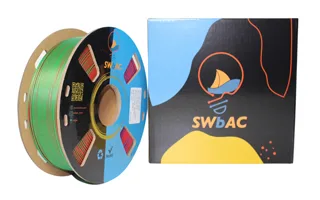
We confidently invite you to experience our SWbAC Signature Filaments, engineered for smoother flow, longer nozzle life, and superior print quality across all major FDM machines.
Explore the range
Frequently Asked Questions (FAQs)
What’s the ideal ratio between nozzle diameter and layer height?
To achieve optimal print quality and reliable adhesion between layers, the recommended layer height is between 25% and 80% of the nozzle diameter. For example, with a standard 0.4 mm nozzle, your layer height should ideally fall between 0.1 mm and 0.32 mm. Staying within this ratio ensures smoother layers, better strength, and efficient extrusion.
Is a larger nozzle better for flexible or composite filaments?
Yes — larger nozzle diameters (0.6 mm or more) are strongly advised when working with flexible filaments like TPU or TPE, as well as composite materials (e.g., carbon fiber or glass-filled ABS). Larger nozzles reduce the risk of clogging and allow for smoother flow, especially for materials that tend to swell or are slightly abrasive.
How does layer height influence print strength?
While there is some debate among researchers, layer height primarily influences print resolution and speed, rather than strength alone. In general:
-
Smaller layer heights (e.g., 0.1 mm) yield better surface detail but take longer.
-
Larger layer heights (e.g., 0.3 mm) print faster and can provide solid strength, depending on part orientation and print settings.
However, overall print strength is also determined by material type, infill pattern, wall thickness, and temperature settings — not just layer height.
We’re here to help you build, learn, and invent.
SWbAC — Kuwait’s home for 3D creation.
“Learn To Invent. Shop To Build.”

0 Comments